Trinity Sunday
- Paulina Hławiczka-Trotman
- May 25, 2024
- 4 min read
Trinity Sunday
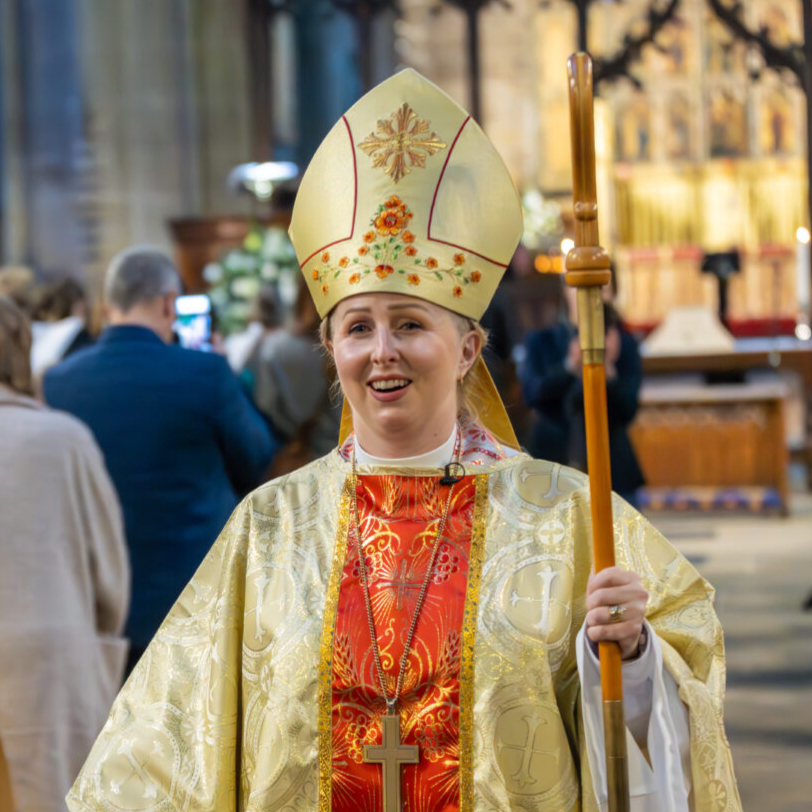
A reflection by Bishop Paulina
“The name of this infinite and inexhaustible depth and ground of all being is God.” P.Tillich
If you hear the word God, what comes to your mind? What is your first image?If you hear – Jesus or Christ, what is your first thought? What’s your feelings on the words Holy Spirit? Who and what do you imagine?
I want to help you to think a little bit differently about the way we usually consider the Holy Trinity.
Our image of God is often within a certain framework like everything else; it is, however, a great mistake when we say that we know God and His works completely, totally, and nothing can surprise us anymore…
In the letter to the Corinthians, there is a definition of something else though: the so-called creatio continua (continuation of creation), and we read it in the words: “so if anyone is in Christ, there is a new creation: everything old has passed away; see, everything has become new!” (2 Cor 5:17 NRSV)
Why do we speak about it today?
For Paul, sarx – the body or flesh in Greek – and its affairs, are something more than just a human body, it is also a point of view: humanity and our human philosophies.
Our flesh is in opposition to God’s spirit, says Paul, if we live only according to the needs of the flesh, it leads us to death. Therefore, God’s act of transformation takes us from the flesh to the spirit. It pulls us out of the material world. We celebrate our body a lot, care about it endlessly. This is especially true in the 21st century. Our body is, however, imperfect; it’s aging, it’s not always healthy. When we feel pain here and there, we forget about the spiritual side of our existence.
“So if anyone is in Christ, there is a new creation: everything old has passed away; see, everything has become new!” (2 Cor 5:17 NRSV)
We must be aware that our body limits us, defines us, and sometimes exerts undue power over us. Even over our mind. Therefore, it is so important to recognise the spiritual as well.
It is not the first times Paul writes to the Corinthians about rejecting the old and accepting the new. In Corinth he faced hardness of heart, criticism, ridicule of his teaching, and unwillingness to accept the new. He also speaks to us today to renew our Christian values.
Unfortunately, when talking about Christian values, we very rarely mention words like: new, different, rebirth, searching, deepening, studying, learning, changing.
We have several values, and we cherish them. We maybe even think that those Corinthians had no values and Paul had to teach them. In contrast we can often believe that we have, after all, plenty of good values and rules, that we have known our Lord well for centuries, and that it is no longer our task to learn something new about our God.
The question I want to ask you is – what are these values? What are they for?
Sometimes we keep them in a nice, elegant box, padlocked in the basement or under the bed. Some have already withered, and some are rotten. Because they lack water, living water, or light, God’s light, or maybe the energy and power of the Spirit. Our values must constantly be renewed, dear friends, because if they do not develop, they die.
We are often busy and worried about the problems of everyday life; we do not hear the cry of the young, and if we do, we do not understand it. Moreover, we do not pray to understand it.
We often get annoyed with new ideas, because they can be an additional task for us, a nuisance, or we consider them to be unnecessary and a waste of time. At times we can even call new ideas demonic. Anything new, or strange, must be coming from a devil.
We can see others as being limited from access to God. For God, however, there are no time limits, no limits at all. Thanks to the mission of Christ, we are all chosen, and thanks to the arrival of the Holy Spirit we have the power of wisdom and, at the same time, of change, and the chance to be reborn according to God’s desire for us.
At the beginning I asked you about your idea of God. Many of us have a specific image of God. We can be lazy or afraid to open up our imagination. That is why I encourage you today to renew your definition of the unique, all-powerful, just, wise, everlasting, and loving God. Let’s not think of God solely through images of a grey-bearded old man as the Creator, or a dove as the Spirit. These can be clichéd and misleading conceptions of God. Nor should we picture Jesus as a blond-haired blue-eyed man who is simply a historical character – indeed he appeared in time and space in a culture where the average person’s skin colour and eyes were darker than those of modern Europeans.
Thanks to the mission of Christ, we are all chosen, and thanks to the arrival of the Holy Spirit we have the power of wisdom and, at the same time, of change, and the chance to be reborn according to God’s desire for us.
To conclude, I wish you to remain realistic but also to open your mind and become a dreamer, constantly preparing yourself for the fact that God can change our thoughts and plans, surprise us and even upset us, disturbing our neat understanding of the world. In all this chaos and busy and difficult times, with disappointment that everything is not as it first seemed to us, do not forget that God has offered you reconciliation, and that you are special, special to God. All this is thanks to the sacrifice of Jesus Christ, and the power of the Holy Spirit, which allows us to participate in all this every day. Amen.


Comments