Sermon for the Week for Prayer of Christian Unity
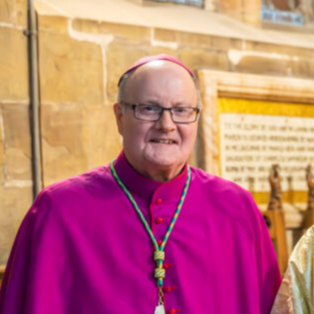
Sermon at St Andrew’s with Castle Gate URC Church, Nottingham, Unity Week 2025
By Rt Rev Patrick McKinney, Roman Catholic Bishop of Nottingham

There are people who argue that ‘ecumenism is currently running out of steam’, but I would very much disagree, and so I am very grateful for the invitation to join you for Worship this morning and also to address you. I would say that, rather than running out of steam, we have actually entered into a very significant period when God’s Holy Spirit is calling the churches, both in their formal dialogues and especially at the local church level, to a deeper understanding and expression of the reality of our present unity in Christ, and to a humble sharing with one another of the gifts and insights we each have within our Christian traditions.
I would like to offer you this thought, that the spiritual term ‘dark night of the soul’, often associated with the writings of St John of the Cross, might be a more accurate term to express something of our current ecumenical situation. The experience of the ‘dark night of the soul’ is often identified with dryness of faith, spiritual burnout or a feeling of emptiness in our relationship with God. It’s most certainly a definite crisis in one’s spiritual life but, like all crises, it’s also an opportunity. If the ‘dark night of the soul’ experience expresses something of our current ecumenical situation, as I believe it does, then I would like to encourage you to see this time as an opportunity, a Kairos moment, when God is inviting and enabling us to repent still more about our lack of unity as Christians, our prejudices about each other, and our inability to pray more often together and to bear a more united Christian stance to the challenges and injustices facing our own society and wider world. I believe this is a time when God is calling us to let Him renew us, and to take centre-stage in all our hearts and minds, as we seek the grace to respond together, and ever more faithfully, to that invitation in the book of Micah, “to act justly, love tenderly, and walk humbly with God”. I believe that this is a time of purification and renewal when God is inviting us, as St Paul in our reading encouraged the Galatians, to let His Holy Spirit, rather than our pride and self-sufficiency, reign in our hearts. If this is our current situation, if where we are ecumenically is not stalemate, is not a running out of steam and new ideas, but is rather a time when we have been experiencing something of the ‘dark night of the soul’ in our ecumenical relations as churches, then perhaps the truth of our current reality is that we are now being called by the Holy Spirit to a time of spiritual ecumenism, when spiritually we seek to draw more closely together, and to a time of what is called ‘receptive ecumenism’.
I believe that we are being called to a time of renewal in our prayer as individual churches, and most certainly in our prayer together; and that this is a time when we are bring called to look upon ecumenical dialogue, as Pope John Paul II once put it as, ‘not simply as an exchange of ideas…but in some way as always an exchange of gifts’. That’s what’s meant by the term ‘receptive ecumenism’, isn’t it. It’s an approach to ecumenical dialogue where there is a humbler and deeper openness and receptiveness to a sharing with each other of the gifts and insights within our traditions, such as about the way we each pray and worship God, the way we understand the scriptures and authority within the Church, grow in our relationship with God, and bear witness to Him in our daily lives. Would we not be all the stronger if we could humbly share with one another our good practice in these areas of church life, spirituality and Christian witness? Perhaps this is a time when we particularly need to heed this important truth: that the work of Christian unity should be less about what we seek to propose and do, and more about us all in prayer seeking together to discern what the Holy Spirit is asking of us? Because where God’s Spirit is leading us as Christ’s Church is surely the true direction for all our ecumenical work and Christian witness.
Many years ago there was a TV programme in which people were taken out into the more remote and wild regions of the UK, and there they were trained to survive without food and to recognise various types of edible plants. Very often, they came to discover that many forms of good healthy nourishment turned out to be plants which they had lived close to all their lives but had never recognised as having life-giving or sustaining value. Once they were helped to see their surrounding environment in a new way, they quickly took advantage of all the riches on offer. Perhaps this is a part of what we are being called to, to a time of renewed spiritual ecumenism, to a similar change of perception towards all the gifts, the riches available to us in each of our Christian traditions, and to a greater willingness to offer and receive them; gifts such as our different liturgies, prayers, hymns, devotional and spiritual practices and approaches to the bible. You would be right to say that we are already quite familiar with each other’s hymns and do make use of them, that we do now explore the various Christian strands of spirituality in that we do enjoy reading spiritual writers from across the Christian traditions, but I think that we would all recognise that there is still much more to be shared and explored together. I believe this is a time when we are being called to move from the question, ‘what do others need to learn from us?’ to the question, ‘what is it that we need to learn from others and be able to receive humbly and graciously?’
In such a scenario of exploring and sharing the richness of the spiritual gifts in each of our Christian traditions, everyone benefits; since we do not lose any of our gifts by sharing them with others, and the gifts we are speaking of are, of course, gifts first received from God and so are given for the good of his whole church. As Martha was challenged by Jesus in today’s gospel reading, ‘do you believe this?, so are each of us. Do we believe this? I, for one, do believe that this is a time when the Holy Spirit is challenging us to be allowed to work more freely in our hearts and in our churches, so as to empower and enable us to act more justly, love ever more tenderly, and walk together ever more humbly with God and with each other.
Thank you, once again, for inviting me to join with you in prayer this morning.


Comments