Bishop Paulina’s Advent Letter to Pastors & Trustees
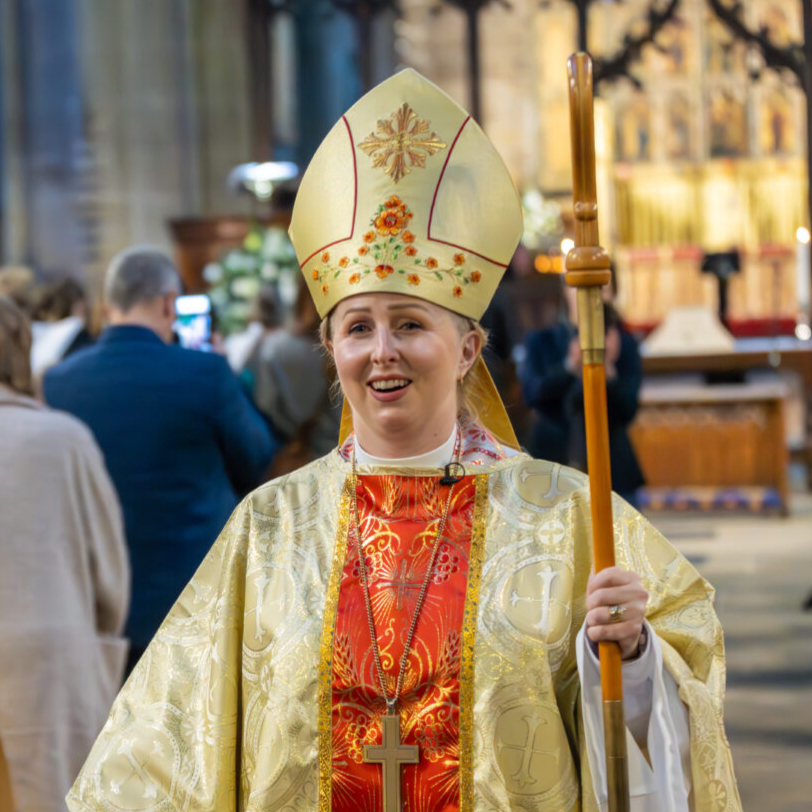
Dear Friends,
In The Lutheran Theology and the Witness of Peace by prof. Richard P. Hordern, Luther College, University of Regina, Canada, written in 1986, we read:
The Lutheran Church is not normally considered to be one of the “historic peace churches” of Christianity. (…) Consequently, the relationship between the Lutheran theological tradition and the pursuit of world peace, with special attention to pacifism, could be considered an attempt to mix “oil and water.” (…) But the gap that might be perceived between the legacy of Martin Luther and today’s peace movement is more a matter of perception than reality. Present-day reflection on peace must center around two significant problems that were absent from Luther’s time and place. When one reevaluates the Lutheran heritage in terms of today’s new meaning of warfare, connections are obvious. (…) Two main fields for discussion are the theory of the “two kingdoms” and the “just war” theory, both of which have received a level of formal recognition in Lutheran church bodies. (…)
We can see how relevant this text still is but also what has changed, and what – as Lutheran leaders – we must add today. During our last Clergy Ministerium Retreat we tried to move from the definition of the “just war” towards the “just peace” theory using the teaching from the Ecumenical Week in Sweden 2025 and the book Decolonising Palestine: The Land, The People, The Bible (2023) by Mitri Raheb, which opened a very interesting, not easy, but necessary discussion.
As we enter the Advent season, a time when the Church dares to speak of light while acknowledging the depth of the world’s shadows, we are invited not to escape the reality of conflict but to interpret it through the coming of Christ. Advent is not a naïve season. Its hymns and Scriptures know the groan of creation, the cries of the oppressed, the powers that resist God’s reign. Yet, the light shines in the darkness, and the darkness has not overcome it. This promise from John 1:5 does not deny the darkness; it sets a horizon beyond it.
In that spirit, our move from a framework of “just war” toward one of “just peace” becomes more than an academic shift. It is an expression of Christian hope, not optimism or sentimentality, but a disciplined confidence in God’s future and justice.
“Just peace” does not ignore human sin or the tragic realities of political life; it calls us to act already as citizens of God’s kingdom: to seek justice without fuelling violence, to protect the vulnerable without repeating cycles of harm, and to ground our judgments not only in what State demands but in what Christ commands, naming violence truthfully and refusing to disguise it.
Our discussions and prayers are shaped by our own ministry experiences and by the concerns of churches and friends affected by conflict, let’s name only a few: Tanzania after the recent election and tragic loss of life of over 3 thousand people, continuous wars in Ukraine and Palestine, and actions against women in Latvia, where parliament voted to withdraw from the Istanbul Convention in October…
It reminds us that Christian ethics must listen first to those who suffer most, and allow Scripture to unsettle our comfortable narratives, including our own. In this way, the pursuit of “just peace” becomes a form of discipleship, calling for humility, attentiveness, and the courage to let God’s future correct our present.
Yet Advent encourages us that such work is not worthless. Even in a world overshadowed by wars – old and new – God is quietly planting signs of reconciliation in places we might least expect. The One who comes as the Prince of Peace does not call us to resignation but invites us to participate, with whatever courage we have, in the healing of our communities and our world. Speaking of “just peace” becomes then not only a theological task but a deeply personal one: it touches how we pray, how we lead, how we listen to the wounded, and how we accompany those entrusted to our care.
My prayer for all of us this Advent is that Christ will renew our hearts with the kind of hope that is steady and grounded, the hope that does not deny the world’s pain, but refuses to let that pain have the final word. May this season give us space to breathe again, to look for the signs of God’s future breaking into our present, and to encourage one another as fellow servants of the Gospel.
And may the peace we long for, and sometimes struggle to believe in, take root in us first, so that we may carry it faithfully into the lives of those we serve.
Pray for me as I pray for you…
Yours,
† Paulina


Comments